
Stargazing in Iran

Cycling routes in Iran
March 22, 2017
Bouali Hotel
May 22, 2018Stargazing is one of the most unforgettable outdoor experiences in Iran. Thanks to its vast deserts, high mountains and exceptionally low light pollution, the country offers some of the clearest night skies in the Middle East. Visitors can admire the Milky Way, observe thousands of stars and enjoy an unforgettable journey through the cosmos.
A Window to the Sky
Stargazing, is one of the unique activities in Iran. You are able to experience the wonders of the desert sky and take a visual journey through the cosmos.
Iran offers numerous destinations for stargazing. The central deserts, Zein-o-din Caravanserai near Yazd, Persepolis in Shiraz, Mesr Desert, Lut Desert and the Valley of Stars on Qeshm Island all provide exceptional opportunities to observe the night sky. Furthermore, these locations are famous for their dark skies and excellent conditions for astrophotography.
| Experience | Season |
| Milky Way begins to appear | Spring |
| Best visibility | Summer |
| Crystal clear skies | Autumn |
| Excellent desert atmosphere | Winter |

Valley of Stars: The unique geology of Iran
Once upon a time in Qeshm Island in Iran, a star fell down from the sky and hit the ground right in the heart and shaped a giant, mysterious, and weird valley which we call Stars Valley or Valley of Stars now.
According to local legend, a star once fell from the sky and created this mysterious valley. However, geologists explain that the spectacular rock formations were shaped over millions of years by wind, rain and natural erosion. Today, the Valley of Stars is one of the most fascinating geological attractions on Qeshm Island.
This geographical site is one of the most unique natural attractions in Qeshm and Iran. Let’s take a closer look at this fascinating natural phenomenon which is also a UNESCO World Natural Heritage Site and the only geopark in the Middle East.
Stars Valley on Qeshm with a historical background of about two million years has been created as a result of soil, stone, and sand erosion caused by the wind, rain, and shower.
The valley is a rare natural masterpiece on the beautiful island of Qeshm. The northern side of Qeshm Island is close to Berke-ye Khalaf Village and has shown its strange geological feature.

Zein-o-din Caravanserai
Zein-o-din Caravanserai is one of the finest places to enjoy the desert night sky in Iran. Visitors can spend the night inside this beautifully restored Safavid caravanserai before stepping outside to admire thousands of visible stars. In addition, camel riding, traditional accommodation and nearby historical attractions make the experience even more memorable.
Stargazing Map of Iran
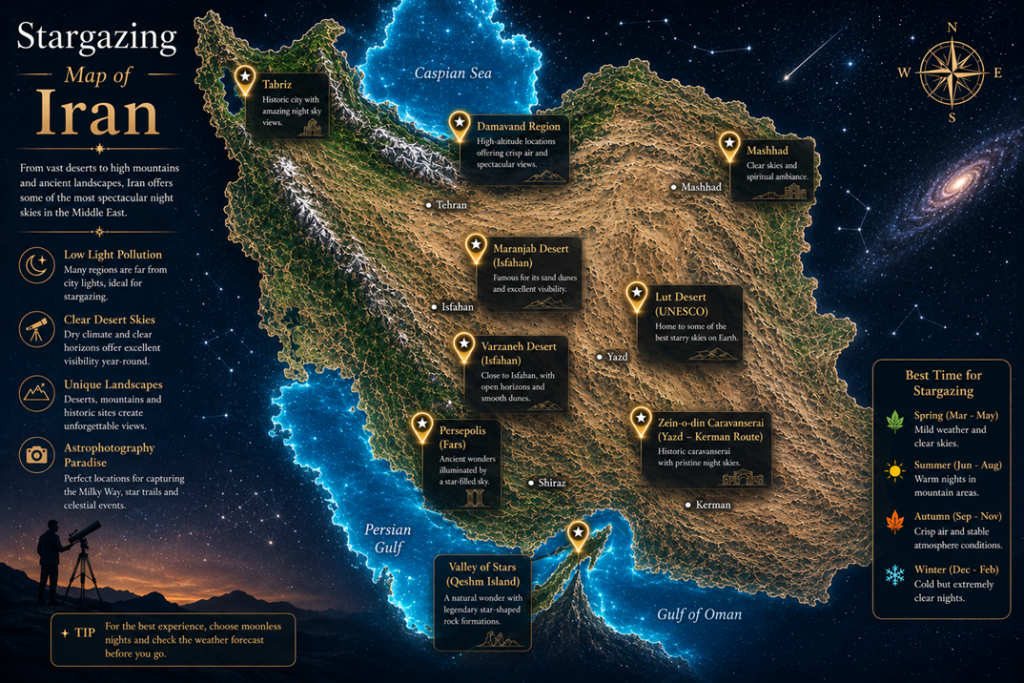
Astrophotography in Iran
Moreover, Iran has become an increasingly popular destination for astrophotography because of its dry climate, wide horizons and remarkably low levels of light pollution.
photography. Far from major cities and sources of light pollution, travelers can photograph the Milky Way, star trails, constellations and meteor showers above some of the country’s most remarkable natural and cultural landscapes.
The Lut, Mesr, Maranjab and Varzaneh deserts offer wide horizons and dramatic foregrounds, while traditional caravanserais, desert villages and rock formations add a distinctive sense of place to every image. Depending on the season, weather conditions and lunar phase, astrophotography experiences can be planned around dark, moonless nights or celestial events.
Both beginners and experienced photographers can enjoy these experiences. A local guide can help travelers reach suitable observation points, understand local conditions and choose safe locations away from artificial light. Photography-focused programs may also include sunrise and sunset photography, desert camping and overnight stays in traditional accommodation.
What You May Photograph
- The Milky Way and the galactic core
- Star trails and constellations
- Meteor showers
- Desert landscapes beneath the night sky
- Historic caravanserais and rural architecture
- Moonlit mountains and rock formations